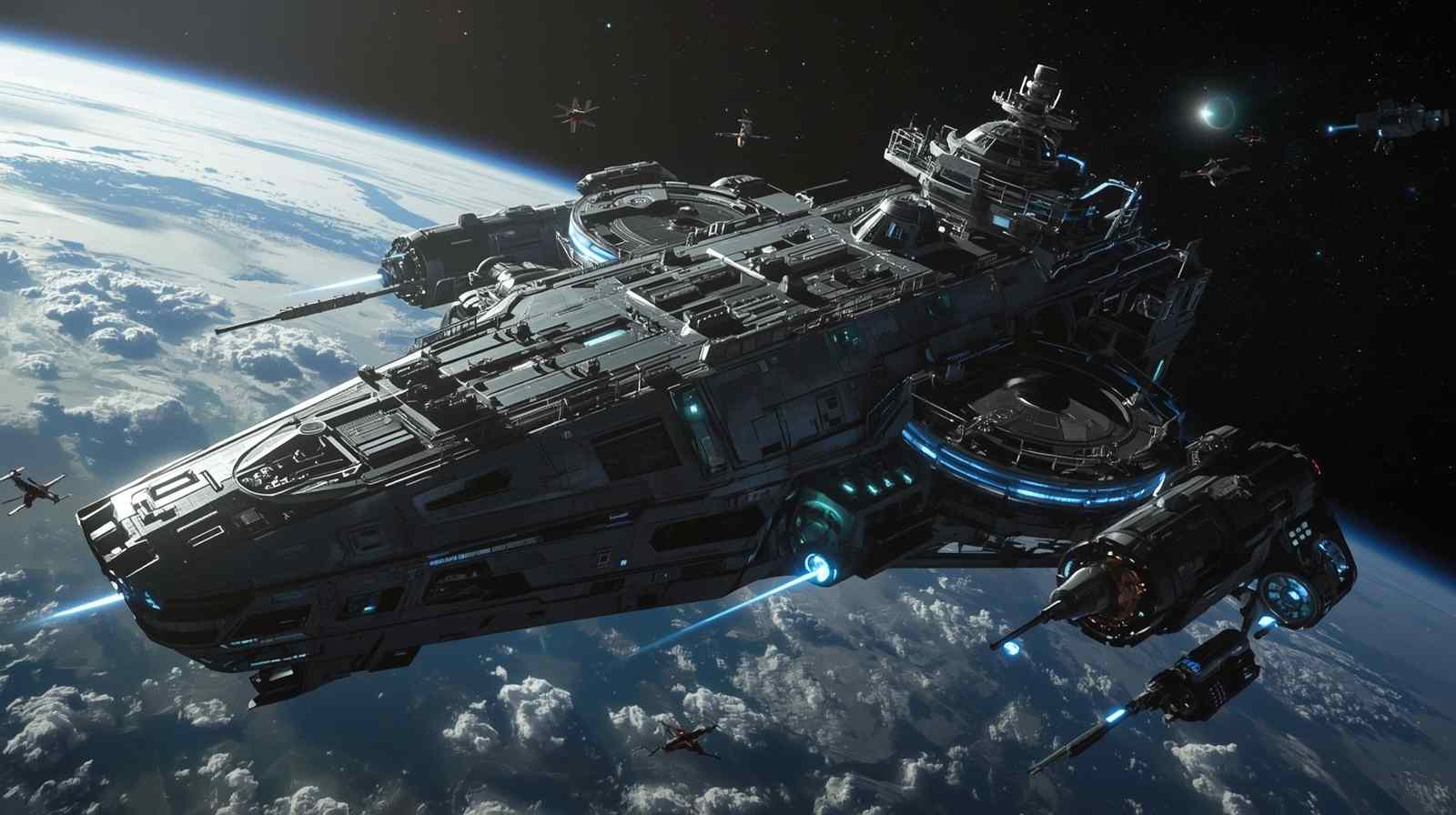
The idea of a Space Force Orbital Warship Carrier is quickly becoming a realistic military possibility as humanity continues to spread beyond Earth. Global Powers in investing in cutting-edge space-based defense systems due to growing interest in deep-space missions, orbital security, and satellite protection.
In the coming decades, an orbital warship carrier, basically a large spacecraft built to deploy, manage, and command military equipment in orbit, may serve as the foundation of space combat.
This article examines what a space force orbital warship carrier would be, how it would function, and why it would change national security, international power dynamics, and warfare in the future.
The Space Force: What is it?
The U.S. Space Force, a division of the Department of Defense, was created in 2019 during the first term of President Donald Trump to safeguard the country's military interests in space and Earth's orbit.
From its Vandenberg Space Force Base in California and Cape Canaveral Space Force Station in Florida, where NASA and commercial launches frequently occur, the Space Force also oversees space launch operations. Before the name change, bases close to Cape Canaveral were known as Vandenberg Air Force Base (VAFB) and Patrick Air Force Base (PAFB).
The Reasons Behind the Global Transition to Space Militarization
Global military changes are directly related to the concept of space force orbital warship carrier. Several factors cause this change:
1. Strategic Competition in Space
The United States, China, and Russia are among the nations making significant investments in space-based military technology. Orbital drones, jammers, and anti-satellite weaponry are already under development. Countries need platforms that can monitor, defend, and react swiftly in space to preserve national security.
2. Dependence on Satellite
Satellites are essential to modern society for:
- GPS guidance
- Networks of finance
- Conversations
- Systems of Weather
- Intelligence from the military.
3. Future Conflicts Begin in Orbit
As more countries deploy satellites, constellations, and space stations, the orbital environment becomes an active strategic battlefield. The first strike in future wars may involve disabling enemy satellites, not traditional land combat.
Key Features of a Space Force Orbital Warship Carrier
Modern technology would be needed for an orbital carrier to be fully operational. Below are the essential components such a vessel would likely have. Comprise
1. Advanced Propulsion System
The carrier may employ the following to maneuver in low-Earth orbit and beyond:
- Ion-based propulsion
- Thermal nuclear propulsion
- Electric engines powered by solar energy
- Long-duration trips without periodic refueling are made possible by these systems
2. Spacecraft Hangars on Board
The carrier would contain:
- Drones for orbital interception
- Micro-satellites for reconnaissance
- Space fighters with personnel
- Repair bots
Its hangar system must support launch, repair, and quick deployment in emergency by its hangar system.
3. Strong Attack and Defense Capabilities
Among the possible weapon systems:
- Lasers with directed energy
- Railguns that use electromagnets
- Missiles that target satellites
- Nodes for cyberwarfare
- Defenses against particle beams
These allow the warship to defend allied space assets while neutralizing adversary threats.
4. Artificial Gravity Habitat
Living conditions that lessen the negative health impacts of zero gravity are necessary for long-term missions. Crew members may experience normal gravitational conditions through the rotation of artificial gravity ring modules.
What Lies Ahead for Orbital Carriers
Although significant obstacles remain, the emergence of orbital warship carriers appears increasingly unavoidable. Breakthroughs in aerospace engineering, artificial intelligence, robotics, and quantum communication are accelerating progress toward this vision. The earliest version may take shape as a compact orbital command module, eventually developing into a fully equipped carrier capable of managing large fleets of drones and autonomous spacecraft.
As innovation continues, these carriers could extend their reach beyond Earth’s orbit to the Moon, Mars, and deeper space, creating a sophisticated network of interplanetary defense platforms.
Possible Applications of Orbital Carrier Technology for Civilian Use
Although the orbiting warship carrier is a military idea, its technical advancements have the potential to revolutionize civilian sectors. Interplanetary travel and space tourism could be accelerated by advanced propulsion systems. Large space hotels, research facilities, and perhaps future colonies could be constructed using orbital building techniques.
Clean electricity could be brought to Earth by advancements in energy generation, such as solar power from space. The foundation of quicker, more secure internet networks around the globe may be laser communication technologies created for military carriers. Thus, all of mankind may gain from the science created for orbital carriers.
The Discussion of Weaponizing Space and Ethical Issues
There are serious ethical concerns with the idea of putting weapons and military platforms in orbit. Opponents contend that militarizing space could result in hazardous confrontations and long-term harm to Earth's orbit. Thousands of pieces of debris can be produced by a single wrecked spacecraft, endangering future space missions, astronauts, and satellites.
Proponents contend that defense systems such as the space force orbital battleship carrier are required because enemies are creating orbital weaponry. As countries decide how to preserve peace while becoming ready for new threats, the issue will continue to have an impact on international policy.
Conclusion
An Orbital Warship of the Space Force Carrier stands for a daring and revolutionary future vision. It is more than just a battleship; it is a representation of humanity's global expansion and an essential measure to safeguard the digital infrastructure that our globe depends on.
Although there are still obstacles to overcome, technology offers countless opportunities. The global balance of power, military operations, and defense policy will all change if orbital carriers are developed.
The orbiting warfare carrier may play a key role in the new era of space security that humanity is entering.
Frequently Asked Questions (FAQs)
1. Is the orbital aircraft carrier real?
The purpose of the Space Force orbital aircraft carrier, also known as the Orbital Carrier, is to pre-position many agile spacecraft that can respond quickly to threats in orbit.
2. Does the Space Force do anything fighting?
Space battle management, electromagnetic warfare, and orbital warfare are missions that promote space superiority.
3. Is the U.S. building a space warship?
The U.S. Space Force has developed an "orbital carrier" capable of launching smaller spacefaring vessels in collaboration with a space engineering firm.