You're comparing apex traffic vs clickseo because you want more visitors now, not after six months of content and backlinks. That's a fair place to start. But almost every article ranking for this exact search pulls from the same recycled script, repeating claims about each tool that contradict each other from one article to the next.
This one does something different: it looks at what these tools actually do, what happens to real sites that use them, and what Google itself says about traffic built this way. You'll leave knowing the mechanics, the risk, and whether either one is worth your money.
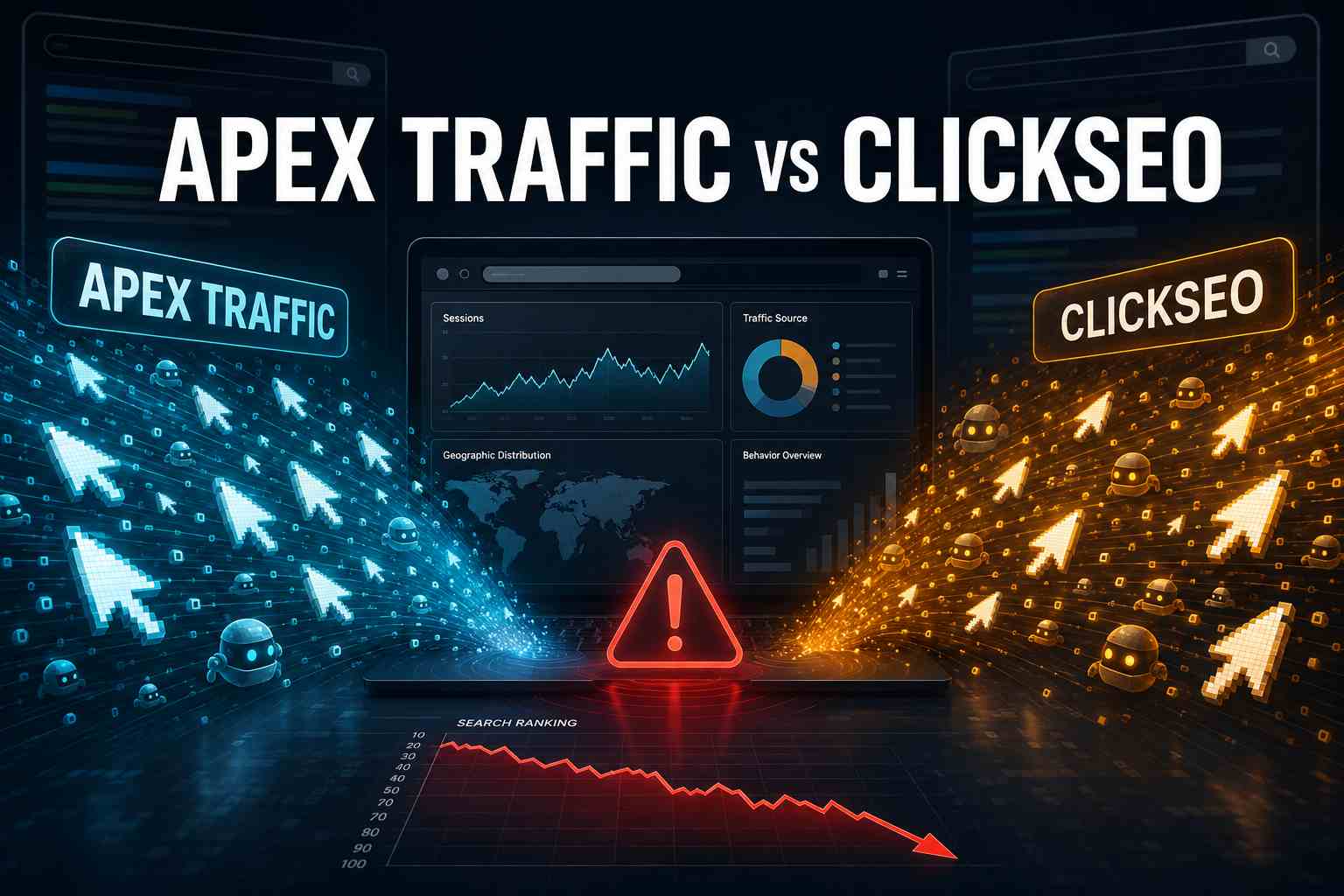
What's the difference between Apex Traffic and ClickSEO?
ClickSEO is a documented click-and-visit simulation service that generates automated search clicks to influence Google Search Console and Analytics data.
Apex Traffic is not one verified product. The name is used loosely by several unrelated SEO agencies and by some of the same traffic-bot vendors that sell tools like ClickSEO, so you need to confirm exactly what you'd be buying before comparing anything else.
How ClickSEO Works
ClickSEO runs as a subscription dashboard. You pick a target URL, a set of keywords, and a country, and the platform sends automated visits that arrive through a search results page rather than a direct link, so they log in Google Search Console and Analytics as search traffic.
You can set session length, scroll behavior, and how often a visit bounces immediately versus browsing further, which lets you shape the engagement numbers a real visitor would leave behind.
The traffic runs through a mix of proxy types. Some vendors in this space lean on residential IP addresses, which are harder to flag because they resemble a home internet connection.
ClickSEO has been reported to mix in datacenter IPs as well, and datacenter traffic is easier for detection systems to separate from genuine visits. A rival vendor's own published audit of ClickSEO found it relying on an unmodified browser automation script for its clicks, the kind of setup that off-the-shelf bot detection is built to catch.
None of that is a design flaw you should try to work around. It's a sign of how thin the line is between "traffic" and "detectable fake traffic," and that line moves whenever Google updates its systems. Which raises the obvious next question: what exactly are you buying when the seller isn't ClickSEO at all?
Plans are typically sold in monthly tiers based on visit volume, with a short free trial to test the dashboard before paying. That pricing structure is one of the first things people notice when they line up apex traffic vs clickSEO side by side, since both lean on subscription tiers rather than a flat one-time fee.
What Apex Traffic Actually Means Before You Pay
Search for Apex Traffic and you'll find agencies offering standard SEO packages under that name, plus articles describing a traffic-bot product that behaves almost identically to ClickSEO or SparkTraffic.
There's no single official site, pricing page, or founder story you can verify the way you can for ClickSEO. If someone is selling you Apex Traffic, ask for the exact product name, the company behind it, and a working link to their terms of service before you hand over payment details.
A tool with no verifiable identity is a bigger risk than a tool with bad reviews, because at least bad reviews tell you something real. Once you've confirmed what you're actually looking at, the features matter less than what the two options share on paper.
Feature Comparison
Factor | ClickSEO | Apex Traffic (generic) |
|---|
Verified single product | Yes, clickseo.io | No, name used by multiple unrelated services |
Traffic type | Simulated search clicks and sessions | Varies by seller; often mixed bot/paid |
Visible in Search Console | Yes, by design | Depends entirely on which service you buy |
Keyword and geo targeting | Yes | Varies |
Free trial | Yes, short trial period | Varies by seller |
Independent reviews available | Yes, mixed to negative | Rarely, given the naming confusion |
A spec sheet only tells you what a tool is supposed to do. What it actually does shows up in the reviews left by people who already paid for it.
What Real Users Report
Public reviews of ClickSEO tell a rougher story than its own marketing.
Site owners describe rankings collapsing after use, with one reporting their site vanished from search results entirely after running the service.
Others describe the tool quietly slowing down or stopping delivery a few billing cycles in, with support going unanswered when they asked for a refund.
A separate site owner posted in Google's own Search Console community that a click-bot attack had suppressed their rankings for twelve months, which shows this kind of automated click activity can hurt a site whether you buy it yourself or a competitor points it at you.
None of this means every account has a bad experience. It means the outcomes are inconsistent enough that you're gambling with a channel you can't fully control once you turn it on.
Read enough of these reports side by side and the apex traffic vs clickseo debate stops looking like a featured question and starts looking like a risk-tolerance question instead.
Why Google Treats This as Manipulation, Not Marketing
Google's spam policies describe link spam as creating links to or from a site mainly to manipulate search rankings, and the same principle extends to any automated activity designed to fake the engagement signals real users would leave behind. Google has also been tightening enforcement around behavior that creates a gap between what a user expects and what actually happens on a page, treating that mismatch as a core problem rather than a technical loophole.
Simulated clicks and sessions sit squarely inside that definition: the traffic looks organic in your dashboard, but no person searched for you and found your page.
If Google's systems catch that gap, the penalty lands on your domain, not on the vendor who sold you the traffic.
If You're Still Considering It, Weigh This First
Artificial traffic can move a vanity metric fast. It rarely moves revenue, because visitors who never searched for your product don't convert like ones who did.
The money is usually better spent on the slower path: content that answers real questions, technical fixes your site actually needs, and outreach for links from sites people already trust.
If you're testing server load or checking how an analytics setup behaves under traffic, that's a narrower, lower-risk use case than trying to fake your way up the rankings.
Weigh the size of your site against the size of the risk, too. A brand-new domain with little organic history has less to lose and less for Google's systems to compare against, while an established site with years of genuine rankings has far more on the line if a manual action or algorithmic demotion follows. That difference matters more than any single feature comparison between the two, because the downside isn't the same for every site.
Frequently Asked Questions
Is ClickSEO traffic real?
No. It's automated, generated by scripts and proxy networks rather than people who searched for your site, even though it appears in your analytics as a search visit.
Can Google detect tools like ClickSEO or Apex Traffic?
Detection isn't guaranteed on any single visit, but Google's spam systems are built to catch patterns of automated engagement over time, and site owners have reported ranking drops tied to this kind of traffic.
Is Apex Traffic the same company as ClickSEO?
No. They're marketed as separate products, but Apex Traffic isn't tied to one verifiable company, so treat any seller using that name as its own case to check individually.
Will artificial traffic tools get my site penalized?
They can. Reports from real users describe ranking drops and, in at least one case, a site disappearing from search results after using a click-bot service.
What's a safer alternative to buying traffic?
Building content around real search demand, fixing technical SEO issues, and earning links from relevant sites all move rankings without putting your domain at risk. If you're weighing that trade-off for your own site, it's worth mapping out what a slower, compliant traffic plan would actually cost you in time before you spend on a bot instead.