If you have searched Anon Vault expecting to land on a clean product page with a download button, you have probably noticed something odd. The results are full of articles describing features and specifications. That is not a coincidence. Anon Vault is not a single product…
It is a category: a shorthand for anonymous, no-account, zero-knowledge cloud storage. And to understand what that actually means, this guide explains the underlying technology behind Anon Vault-style storage. It also covers the trade-offs involved and, more importantly, how to evaluate any service making these types of promises before trusting it with sensitive files.
What you will learn
Why is Anon Vault a category of storage tools, not a single verified product
How client-side encryption and zero-knowledge architecture actually work
A five-point checklist to verify any service before trusting it with your files
How Anon Vault compares to audited alternatives like Proton Drive and Filen
What Is Anon Vault?
Anon Vault refers to the class of anonymous, zero-knowledge cloud storage. It allows you to store files without creating an account that is linked to your identity. It operates in a way that files first get encrypted on your device before they are uploaded, so the provider never has access to your decryption key. For additional privacy, you can use Tor routing to hide your IP address. It is a category of tools, not one single listed product.
Google Drive, Dropbox, or OneDrive, which require an email address and that is the link to your identity and your storage, and operate under terms of service that permit content scanning.
But an Anon Vault-style platform aims to remove the provider from the trust equation entirely. According to the 2026 analysis by Novabiztechnology.com, AnonVault isn't a single official app or service. Instead, it's a broad term used to describe anonymous, no-KYC cloud storage solutions that have appeared across tech blogs, forums, and niche websites, often under different names and branding.
How the Technology Behind Anon Vault Storage Works?
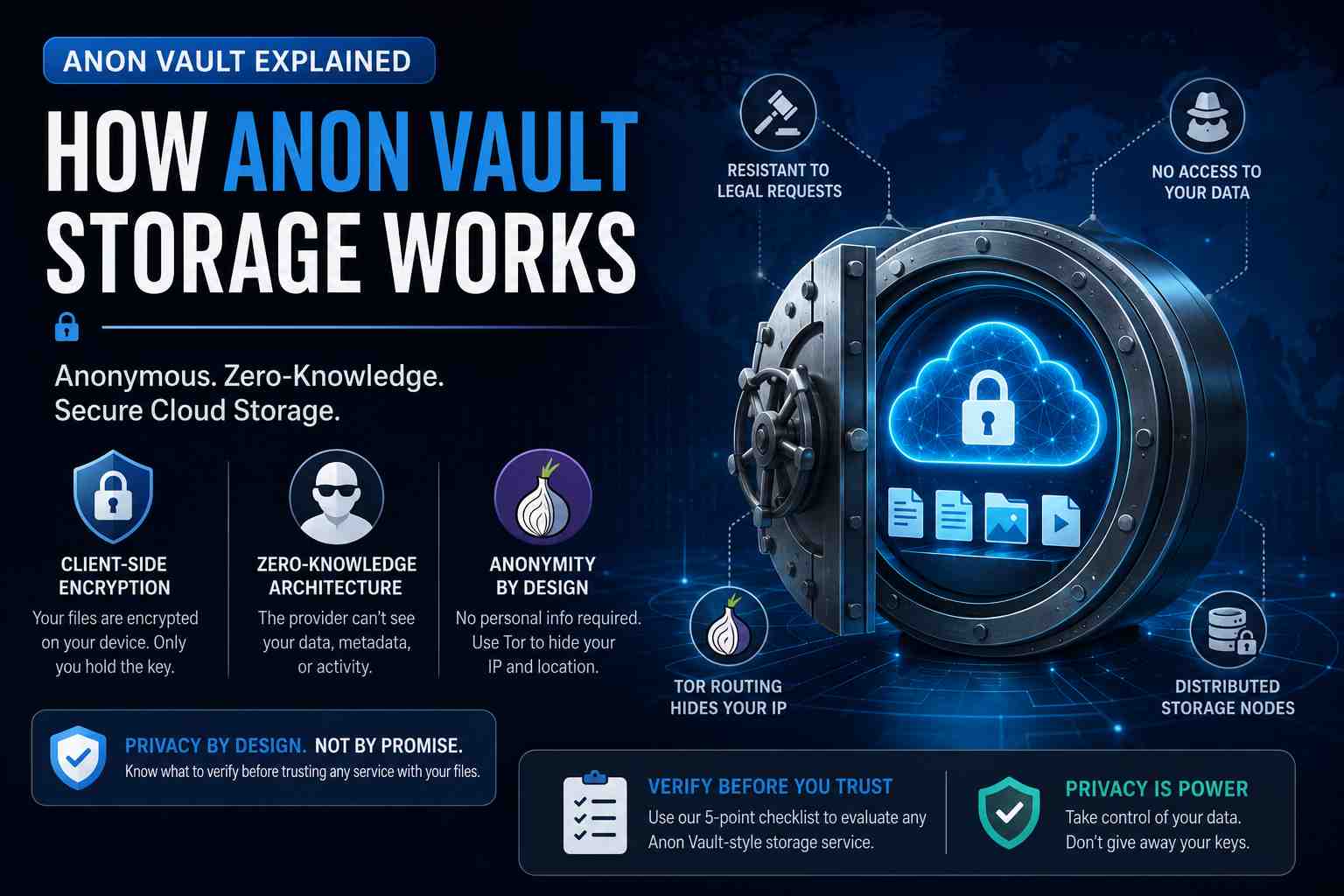
The guarantee of Privacy of any Anon Vault depends entirely on three most important technical layers that work together, and if any one of them fails or is absent, the claim of anonymity collapses.
Client-Side Encryption
THE CORE MECHANISM: Your file is encrypted on your device before it ever uploads.
The client derives an encryption key locally using a key derivation function such as Argon2 or PBKDF2, then encrypts the file with AES-256-GCM, which is the same standard the U.S. government uses to protect classified information. The service receives only ciphertext, a scrambled version of your file, that requires a key to decode it.
The provider is never able to get your key. That means it cannot read your file even if compelled by a court order or hit by a breach.
Zero-Knowledge Architecture
THE CORE MECHANISM: The design makes reading your data impossible for the provider, not just prohibited.
It means the service cannot see what you store, when you access it, or what it contains, and this is because the design makes looking into it impossible. A strict zero-knowledge metadata policy means the service cannot see file sizes, upload times, or content types.
This matters because metadata alone can be extraordinarily revealing. The timing and size of uploads can identify individuals even when the content is fully encrypted
Identity and IP Anonymity
THE CORE MECHANISM: Your "identity" on the platform is a cryptographic key, not your name or email.
Most Anon Vault services allow account creation without a phone number or email. Users can reroute their connection through the Tor network. This masks both the location and the identity of the user. The platform distributes stored content across multiple nodes rather than a single server. Without Tor or a VPN, your IP address can link your activity to your physical location, regardless of how well your files are encrypted.
Why Demand for Anonymous Storage Is Growing
The appetite for AnonVault-style storage is not rooted in paranoia; it is driven by documented, measurable erosion of trust in mainstream providers.
81% of U.S. adults are very or somewhat concerned about how companies use the data they collect about them ~ Pew Research Center, 2023 survey of 5,101 U.S. adults. The share of Americans who say they understand little to nothing about what companies do with their personal data rose from 59% to 67?tween 2019 and 2023 ~ Pew Research Center
Those concerns translate directly into demand for storage that does not require trusting a corporation with your encryption keys. Standard cloud platforms encrypt files at rest, but they hold the keys. That means a subpoena, a data breach, or a rogue employee can expose your files.
Anon Vault-style storage dismisses that risk entirely: because the provider never holds the key, none of those scenarios puts your data at risk.
Who Actually Needs Anon Vault Storage?
Not everyone. These tools trade convenience for privacy in real, costly ways. Here is who benefits most, and why.
1. JOURNALISTS AND SOURCE PROTECTION:
Journalists often need to store sensitive documents while protecting the identity of confidential sources. Anon Vault-style storage with Tor routing addresses that are directly accessible in a way that traditional cloud services, such as Google Drive, never are and can be disclosed in response to legal requests.
2. CRYPTOCURRENCY HOLDERS:
Users can store private keys, seed phrases, and backups of digital wallets.
Mainstream cloud storage creates a single, identity-linked point of failure. Anon Vault removes the identity link entirely. It is best suited for storage needs under 500 GB, but larger volumes often hit speed or cost walls.
3. HEALTHCARE AND LEGAL PROFESSIONALS:
Professionals often handle highly sensitive client or patient information. Client-side encryption helps protect these files by ensuring that even the provider cannot read them.
However, healthcare organizations still need proper legal agreements before using any service for patient data.
4. ACTIVISTS AND AT-RISK INDIVIDUALS:
Protecting sensitive files and communications in countries with heavy surveillance. Tor-routed, zero-knowledge storage removes the identity trail that makes targeted surveillance possible. The protection is structural, not policy-based.
5. EVERYDAY PRIVACY SEEKERS:
File storage without corporate data tracking or identity linkage. But with a warning. This group is the largest but also the most likely to find the trade-offs frustrating. There is no password reset. No customer support can recover your files. Losing your passphrase means your data is gone permanently.
What to Check Before Trusting Any Anon Vault Service
This is the section most competitor articles skip, and it is the most important one. A service that cannot be independently verified is asking for a level of trust that nobody has earned on its behalf.
Work through this checklist before uploading anything sensitive. A service that fails three or more points is not necessarily fraudulent, but it is asking you to trust a claim rather than a verifiable technical fact.
5-POINT VERIFICATION CHECKLIST
1. INDEPENDENT SECURITY AUDIT
Always look for a service that provides its audit report publicly. Services like Proton Drive, Tresorit, and Filen publish these. If a service that makes zero-knowledge claims has never been audited, the claim is unverifiable, full stop.
2. OPEN-SOURCE OR OPEN-AUDITABLE CLIENT CODE
Zero-knowledge encryption only protects you if the client software actually implements it correctly. Closed-source clients require trusting the vendor's word with no way to verify it.
3. CLEAR JURISDICTION DISCLOSURE
The location of the servers of service providers is an extremely crucial matter because it determines which government can legally request your data. Privacy-friendly regions such as Switzerland, Iceland, and the EU usually offer stronger protections than services with unclear or undisclosed jurisdictions.
4. IDENTITY-FREE PAYMENT OPTIONS
A service requiring a credit card or PayPal links your financial identity to your account, often the most traceable piece of information you can leave. Services accepting Monero or similar privacy coins are preferable for genuine anonymity.
5. STABLE DOMAIN AND VERIFIABLE OPERATOR
A small character mistake in the web address can take you to a fake site that is designed to steal your credentials. A missing team page, unclear ownership, and multiple similar domains are major warning signs that should not be ignored.
The Real Trade-Offs of Zero-Knowledge Storage
Every privacy technology involves compromises. AnonVault-style storage has the same, and understanding these three trade-offs is essential before relying on it for any sensitive data.
1. PERFORMANCE
Device-side encryption and Tor routing demand extra processing power, which can slow uploads noticeably. Distributed storage across multiple nodes may also affect speed on weaker connections. For large files or frequent access, the penalty is real and consistent.
2. ACCOUNT RECOVERY
You cannot recover your data if you lose your key. In a genuine zero-knowledge system, no one can reset your password or retrieve your files. That is a feature, not a flaw, but it has real costs for users not accustomed to managing cryptographic credentials. Lose your passphrase, and the data is gone permanently, with no recourse.
3. LEGAL AND REGULATORY CONTEXT
The assumption that the regulatory environment stays stable. Anonymity tools are not illegal in most jurisdictions, but the weather is shifting.
According to Hacken's 2025 tracker, many countries now require financial services to collect and share more user information, even in areas that previously allowed greater anonymity. As a result, privacy-focused tools are facing increasing regulatory pressure.
Using anonymous storage services for legitimate purposes is legal in the United States and the European Union. Using them to hide illegal activity is not.
Anon Vault vs. Established Privacy Storage Alternatives
If the idea of AnonVault-style storage appeals to you but concerns about verification make you hesitate, several established alternatives offer similar privacy benefits with proven track records.
Service
| Audit
| Open Source
| Jurisdiction
| Anonymity Level
|
|---|
Anon Vault (category) | Unverified | Varies | Often undisclosed | High, no account needed |
Proton Drive | Yes | Yes | Switzerland | Medium, email required |
Filen | Yes | Yes | Germany (GDPR) | Medium, account required |
Tresorit | Yes | No | Switzerland / EU | Low, identity required, enterprise focus |
Proton Drive, Filen, and Tresorit have been independently audited and their results are public. Most Anon Vault sites have not. For most privacy needs short of extreme anonymity, Proton Drive or Filen are the more defensible choice. For legal, healthcare, or enterprise use, Tresorit's GDPR-aligned model is purpose-built for compliance environments.
Frequently Asked Questions
What is the Anon Vault used for?
Anon Vault refers to anonymous, zero-knowledge cloud storage. It is a category of service that lets you store files online without creating an account linked to your identity.
It is used by journalists protecting sources, activists avoiding surveillance, cryptocurrency holders storing private keys, legal and healthcare professionals managing sensitive records, and individuals who want file storage without corporate data tracking.
Is Anon Vault a single product or a category?
It is a category, not a single verified product. The term has appeared across privacy forums and tech blogs since 2025. It describes a range of services sharing similar features: no-KYC account creation, client-side AES-256 encryption, and optional Tor routing.
How does Anon Vault encryption actually work?
Files are encrypted on your device before upload using AES-256-GCM, a cipher used to protect classified U.S. government data. Your decryption key is generated and stored locally. The service never receives it.
What happens if you lose your Anon Vault password?
If you lose your passphrase or cryptographic key, it means the permanent and unrecoverable loss of your data. There is no "forgot password" option because the service does not hold your key.
Is Anon Vault legal?
Storing files using anonymous, encrypted storage is legal in the United States and the European Union. The legality of any specific service depends on its jurisdiction of operation and whether the user's purpose is lawful.