Last updated: 6 November 2026
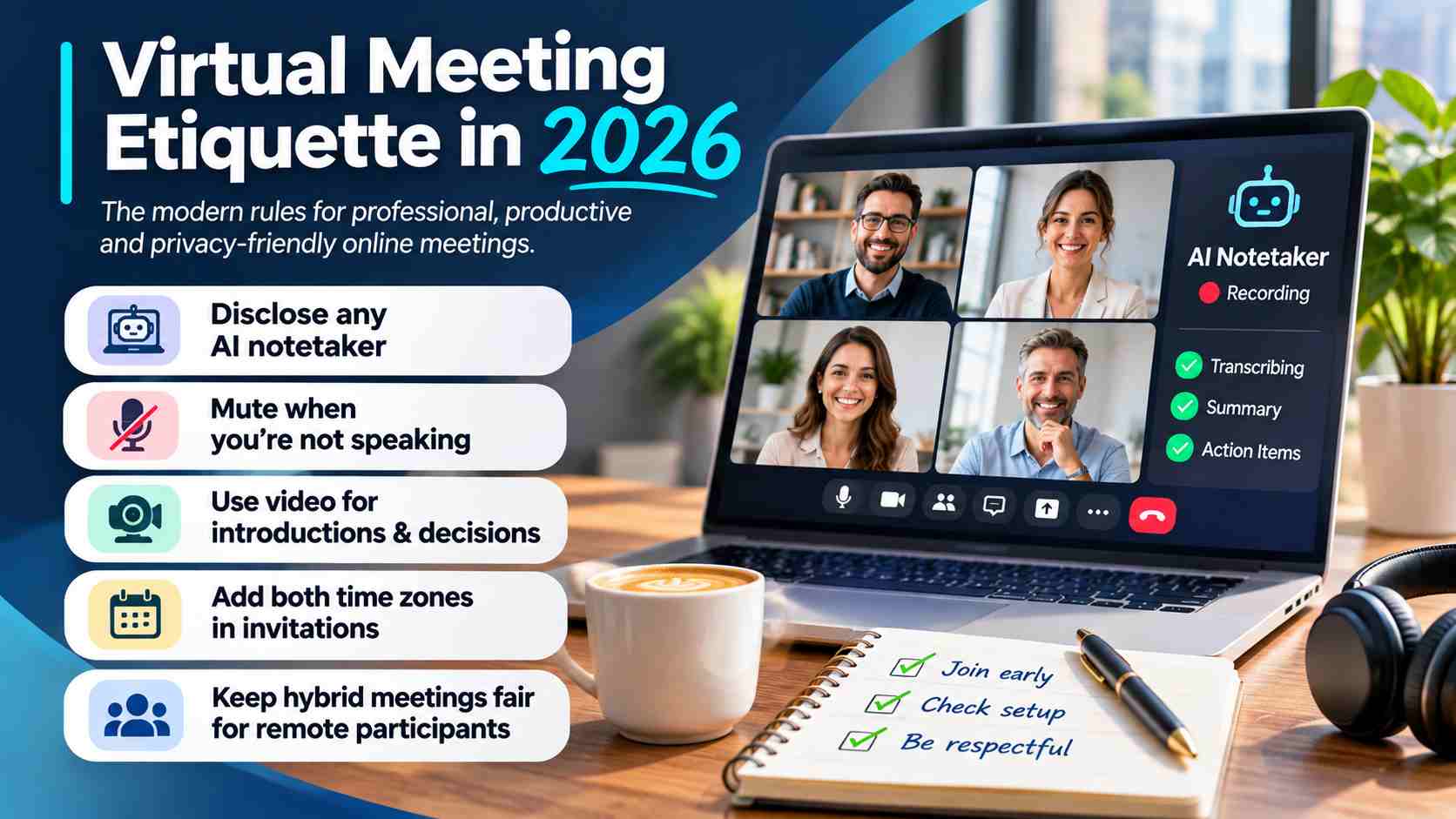
Quick answer: Good virtual meeting etiquette in 2026 still means muting when you're not speaking, checking your lighting, and joining a few minutes early. But the biggest rule is new: if an AI notetaker is recording, tell everyone at the start and turn it off if someone objects. In all-party consent places like California and under UK GDPR, that disclosure isn't just polite. It's expected by law.
Key takeaways
- Announce any AI notetaker at the start of the call, and stop it if anyone objects.
- Rename the bot so people know whose it is and what it does.
- Video on for introductions and decisions; optional after that.
- Put both cities in the invite when you schedule across the US and UK.
- In hybrid rooms, make sure remote people can hear, see, and speak first.
Picture this. You join a client kickoff on Zoom. A normal call, or so you think.
Halfway through, a participant named "Otter Notetaker" pops into the list. You didn't invite it, and nobody else says they did. It transcribes the whole conversation, then emails a summary to people you've never met. You find out from the summary itself.
Yeah. That's the moment the old etiquette advice starts to feel a little thin.
This isn't far-fetched. It's close to what the plaintiffs allege in In re Otter.AI Privacy Litigation, a case moving through the Northern District of California in 2026. And it's why I think virtual meeting etiquette has a new central question.
Not "is your mic muted?" but "does everyone on this call know who, or what, is listening?"
The old rules still matter. Mute when you're not speaking. Check your lighting. Join a few minutes early. But those are table stakes now. The real etiquette gap is consent.
How Have AI Notetakers Changed Meeting Etiquette?
I'm not going to say that mute buttons don't matter. They do. In my experience, people still complain about background noise. Lighting and framing matter too, because they shape how others see you. And to avoid technical chaos, join early.
But those rules assume the meeting is live and temporary. That assumption is not safe anymore.
AI notetakers, like Otter, Fireflies, Fathom, and Read AI, now join calls by default in a lot of organizations. They capture audio, generate transcripts, and send out summaries. Sometimes the host turns them on. Sometimes they're already on. Sometimes they join silently, as a named attendee nobody remembers inviting.
That changes the etiquette equation. It's no longer just about how you present yourself. It's about whether the people on the call know what's happening to their words.
The Otter case is one of the most prominent examples. Justin Brewer, who says he never had an Otter account, sued in August 2025 after an Otter Notetaker joined a Zoom call he attended. Three more suits were consolidated with his. On August 13, 2026, Judge Eumi K. Lee partly granted Otter's motion to dismiss, but let the federal wiretap, California privacy, and Illinois biometric claims go forward.
We don't know yet whether Otter broke the law. These are still allegations. But the case is serious enough that businesses using AI meeting assistants should pay attention, because the consent rule underneath it matters more than the verdict. California requires all parties to consent before a confidential conversation is recorded. So do several other states, including Florida, Illinois, Pennsylvania, and Washington. California has even applied its rule to out-of-state recordings of calls with Californians.
In the UK, GDPR Article 5(1)(a) says personal data has to be processed lawfully, fairly, and transparently. The ICO ties transparency directly to fairness. A voice recording identifies you, which makes it personal data. Your London colleague expects to know that a recording exists, why it exists, and who will see it.
So here's the practical takeaway. If anyone on the call is in an all-party consent state or the UK/EU, treat the call as one where disclosure is required. Not optional. Required.
What Should You Say Before an AI Notetaker Starts?
I've started using a script at the start of every call where a notetaker is active. It takes about 20 seconds.
"I'm running an AI notetaker for action items. It saves the transcript to our team folder. If you'd rather it stay off, tell me now."
Then I wait about three seconds. If someone objects, I turn it off and take notes by hand. Recording everyone except the objector doesn't work. Their voice is still on the audio.
I'll be honest: the first few times felt awkward. Like I was making a big deal out of nothing. But the alternative is worse. Someone finds out later that their voice was recorded and summarized without their knowledge. And in all-party consent jurisdictions, it's not just awkward. It can be illegal.
One more thing. Rename the bot in the participant list. A default name like "Fireflies Notetaker" reads as spam to a new client. "Sarah's Otter (AI notetaker)" is clearer. It's a small change, but it makes a big trust difference.
Should Your Camera Be On in Virtual Meetings?
Camera norms deserve a mention. But the evidence is thinner than most office policies assume.
Stanford's Jeremy Bailenson laid out four causes of video fatigue in a 2021 paper: long stretches of close-up eye contact, seeing yourself constantly, sitting still for hours, and the extra effort of reading nonverbal cues on video. He framed it as a theoretical argument that still needed direct tests. So treat it as a strong lead, not gospel.
Two fixes I actually use: hide your self-view once your framing is set, and shrink the meeting window so faces stop looming. A reasonable middle rule? Video on for introductions and decisions. Optional after that.
How Do You Schedule Meetings Across US and UK Time Zones?
Then there's the clock problem. In 2026, UK and EU clocks go back on October 25. US clocks wait until November 1. For those seven days, London and New York are four hours apart instead of five. A 14:00 London call lands at 10:00 in New York that week. The week after? 09:00.
Put both cities in the invite. Spell them out. Abbreviations like EST and EDT are where people slip.
How Do You Run a Fair Hybrid Meeting?
In a hybrid room, the room wins by default. Voices carry. Jokes land. Remote folks catch the second half of every sentence. So push back:
- Repeat questions into the microphone.
- Keep side remarks in the chat.
- Invite remote attendees to speak first.
- Describe what's on the shared screen.
- Turn on live captions.
These aren't niceties. They're the difference between remote colleagues contributing and remote colleagues tuning out.
If your team still struggles to keep online meetings lively, these ways to make online business meetings more engaging may help. And if you often join calls on the road, see our tips on staying productive on business trips.
Etiquette Is About Disclosure Now, Not Polish
I'll say it plainly. Virtual meeting etiquette in 2026 is less about how polished you look and more about whether the people on the call know what happens to their words afterward.
The mute button, the lighting, the join-early habit: they still matter. But they're not the whole job anymore.
The 20-second disclosure script is the highest-leverage change you can make this week. It costs almost nothing. It lowers your legal risk in all-party consent jurisdictions. It builds trust with clients and colleagues. And it signals that you're the kind of host who thinks about other people's data, not just your own convenience.
Your Next Step
Before your next call, write your own disclosure sentence. Say it out loud once. Then use it. If you want a template, start with mine and adjust it to your team's tools.
This article is general guidance, not legal advice. If your team records calls often, check the rules that apply where your participants are.
Sources
Frequently Asked Questions
Do I have to tell people I'm using an AI notetaker?
Yes. Virtual meeting etiquette and the law point the same way here. In all-party consent states such as California, recording without everyone's agreement can break the law, and the UK GDPR transparency principle expects participants to be informed. Say it aloud at the start.
Is it rude to keep my camera off?
Not automatically. Bandwidth, privacy, and fatigue are all reasonable causes. If the group has a camera norm, tell the host in advance, then stay visible through chat or voice.
How early should I join a virtual meeting?
For a routine call, a couple of minutes is enough. For client calls, interviews, or a platform you rarely use, test audio and screen sharing 10 to 15 minutes ahead.
How do I schedule across US and UK time zones?
Name both cities in the invite and check the date, since the US and UK change clocks on different weekends. The gap is five hours most of the year and four when one side has changed clocks first.