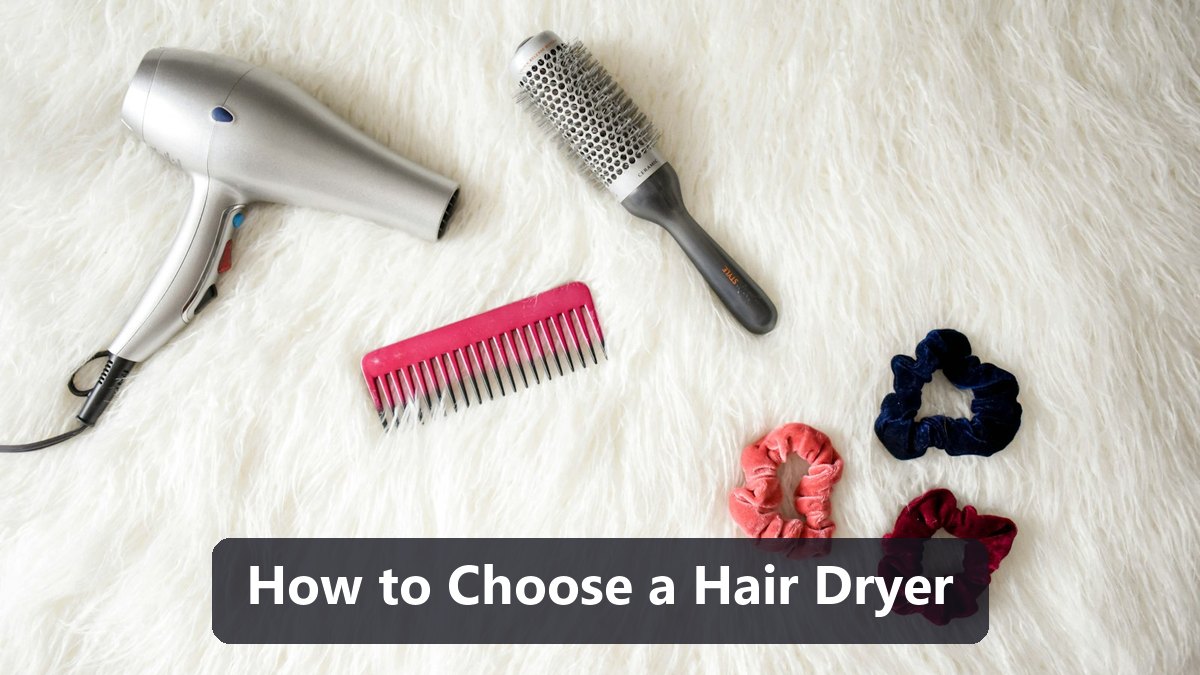
Pick a hair dryer that suits your hair type first. Then look at power, motor, heat settings and weight. Fine or short hair does well with a lighter, lower-power dryer that has a low heat setting. Thick, long or coarse hair dries faster with a stronger motor and a concentrator nozzle. Curly hair needs a diffuser. Everything else is a bonus.
Most people buy a dryer by brand or price and then wonder why their hair still takes 20 minutes or comes out frizzy. The fix is usually simple: the dryer doesn't match the hair. Here are the seven things worth checking before you pay.
1. Start With Your Hair Type
This one decision narrows the list more than anything else.
- Fine or thin hair: Use lower heat and gentle airflow. Strong, hot air can make fine hair flat or frizzy. A dryer with at least two heat settings and two speeds is enough.
- Thick or coarse hair: Look for more power and a narrow concentrator nozzle. You'll cut drying time, and less time under heat means less damage.
- Curly or coily hair: Get a diffuser attachment and low to medium heat. The diffuser spreads the air out so curls keep their shape instead of blowing apart. Our guide to blow-drying curly hair covers the technique.
- Damaged or color-treated hair: Choose a dryer with real temperature control, not just "hot" and "hotter", and a cool shot button.
If two people share the dryer and have very different hair, buy for the one who needs more control, not the one who needs more power.
2. Wattage: Enough Power, Not the Most
Wattage tells you how much power the dryer pulls. More watts usually means stronger, hotter airflow and faster drying.
- In the US, most dryers top out at 1,875 watts. That's plenty for almost every hair type.
- In the UK and Europe, outlets run on 220–240 volts, so 2,000–2,400W models are common.
- For fine or short hair, a mid-range model is fine. For long or thick hair, aim for the upper end of what's sold in your country.
Don't treat wattage as a quality score. A well-designed 1,600W dryer with a good nozzle can dry faster than a cheap 2,200W one. Airflow and design matter as much as the number on the box.
3. Motor Type: AC, DC or Brushless
The motor decides how heavy the dryer feels, how strong the airflow is and how long the dryer lasts.
| Motor |
What it's like |
Best for |
| AC |
Heavier, powerful, built to run for long periods |
Salons, thick hair, daily heavy use |
| DC |
Lighter and cheaper, but usually doesn't last as long |
Most home users, travel |
| Brushless (digital) |
Very light, fast airflow, usually quieter, expensive |
People who dry often and want a light tool |
If your current dryer gets hot in the handle and dies after a year or two, it was probably a basic DC model. Moving to an AC or brushless motor is the biggest upgrade you can make.
4. Heat and Speed Settings
Heat does the drying, but too much of it damages the outer layer of the hair (the cuticle). Good settings let you use only as much heat as you need.
Look for:
- At least two or three heat levels and two speeds.
- A cool shot button. A blast of cool air at the end helps set the style and adds shine.
- Separate heat and speed controls. Then you can use high speed with low heat, which is the kindest combination for most hair.
Distance matters too. A 2011 study in the Annals of Dermatology tested dryers at different distances. Holding the dryer about 15 cm (6 inches) away and keeping it moving caused less damage than air-drying. Heat from up close at 5 cm (about 95°C) damaged the cuticle. (Lee et al., 2011)
5. Ionic, Ceramic or Tourmaline?
These words appear on almost every box, so here is what they mean:
- Ionic: The dryer releases negatively charged ions. Brands say this breaks up water drops faster and reduces static and frizz. Many users with frizzy hair notice smoother results, but the science is limited, so think of it as a nice extra, not magic.
- Ceramic: A ceramic heating element or coating spreads heat more evenly and avoids hot spots. It's a good choice for fine or damaged hair.
- Tourmaline: A mineral coating marketed as producing more ions than ceramic alone. It usually comes on higher-priced models.
If frizz is your main problem, an ionic dryer with a ceramic element is a sensible pick. If your hair is already smooth, don't pay extra just for these labels.
6. Attachments That Earn Their Place
Most dryers come with one or two attachments. Only two really matter:
- Concentrator nozzle: A flat, narrow nozzle that points the air exactly where you want it. Use it for straight, smooth styles and when drying with a round brush.
- Diffuser: A wide, bowl-shaped attachment for curls and waves. It dries the hair without blowing out the curl pattern.
Check that attachments click on firmly. If a nozzle falls off halfway through drying, you'll stop using it. Some premium dryers also include smoothing or gentle-air attachments, which are useful but not essential.
7. Weight, Cord and Everyday Comfort
You'll hold this tool at shoulder height several times a week, so comfort matters more than most reviews admit.
- Weight: Pick it up in the store if you can. If holding it at arm's length for a minute feels tiring, it will feel worse with wet, long hair.
- Cord: A longer cord gives you room to move, especially if the outlet isn't next to the mirror. A cord that swivels at the base tangles less.
- Buttons: They should sit where your thumb rests, so you don't change settings by accident.
- Noise: Brushless motors are usually quieter. That helps if you dry your hair early in the morning.
- Travel: If you travel abroad, choose a dual-voltage or folding travel dryer. Using a single-voltage US dryer on a 230V outlet can burn it out, even with a plug adapter.
Safety and Care Checks
A good dryer can still fail early if you ignore these:
- Safety plug (US): The big block on the plug of US dryers is a shock-protection device that cuts power if the dryer gets wet. Don't buy a dryer without one, and never use it near a full sink or bath.
- Overheat protection: A thermal cut-off switches the dryer off if it gets too hot. Most trusted brands include one.
- Clean the filter: Pull lint and hair off the back filter about once a month. A blocked filter makes the motor work harder, adds heat and shortens the dryer's life. If your dryer suddenly smells hot or cuts out, check the filter first.
- Warranty: Two years or more is a good sign the maker trusts the motor.
Quick Picks by Hair Type
| Your hair |
Look for |
| Fine or thin |
Lightweight, low heat setting, ceramic, cool shot |
| Thick or coarse |
High wattage, AC or brushless motor, concentrator nozzle |
| Curly or coily |
Diffuser, low/medium heat, ionic |
| Frizzy |
Ionic plus ceramic, cool shot |
| Damaged or color-treated |
Precise temperature control, ceramic, low heat |
| Short hair, quick styling |
Compact DC model is enough |
| Frequent traveler |
Dual voltage, folding handle, light weight |
Once you've picked a dryer, a good cut makes styling quicker too. Browse our hairstyles for women or see how to get a classic slicked-back look for men.
Frequently Asked Questions
What wattage hair dryer is best?
For most people, 1,600–1,875 watts is the sweet spot in the US. In countries with 220–240V outlets, 2,000–2,400W is common. Thick or long hair benefits from the higher end. Fine hair doesn't need maximum power.
Is an ionic hair dryer better?
It can be if your hair gets frizzy or full of static. Ionic dryers are designed to cut drying time and smooth the hair, but they're not essential if your hair is already smooth.
Which hair dryer is best for curly hair?
Choose one with a diffuser attachment, low to medium heat settings and a cool shot button. Ionic technology can help with frizz. Also see whether hot water makes hair curly.
Is it better to air-dry or blow-dry hair?
Both have trade-offs. A 2011 lab study found that a dryer used at about 15 cm and kept moving caused less overall damage than air-drying. Heat held close to the hair damaged its surface.
How long does a hair dryer last?
It depends on the motor and how you care for it. AC and brushless motors generally outlast basic DC motors. Cleaning the filter regularly also helps the dryer last longer.
Can I use my hair dryer in another country?
Only if it's dual voltage. A single-voltage dryer can overheat or burn out on a different voltage, even with a plug adapter. Check the label near the cord for the voltage range.
Sources
- Lee Y, et al. "Hair Shaft Damage from Heat and Drying Time of Hair Dryer." Annals of Dermatology, 2011; 23(4): 455–462. PMC3229938