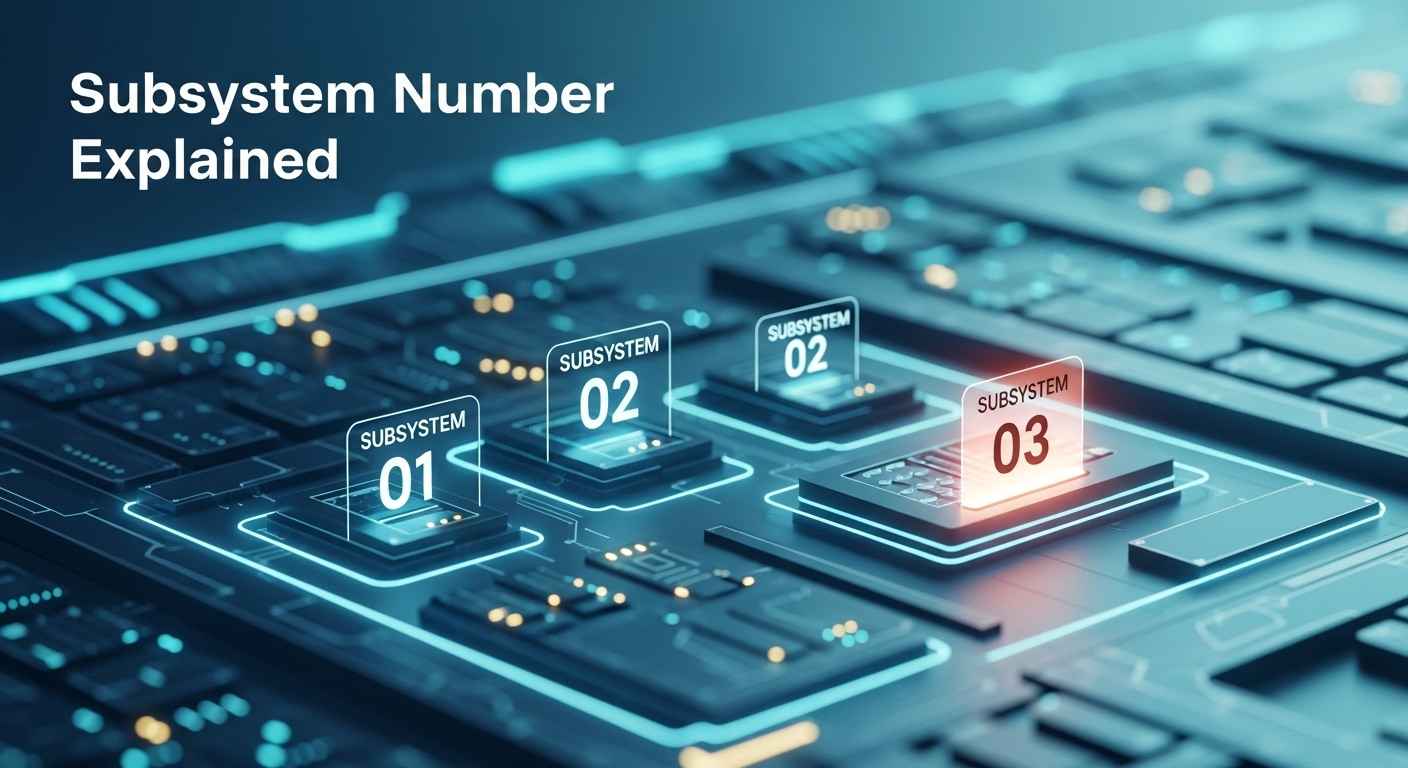
The term subsystem number is widely used in computing, engineering, networking, and enterprise systems. It refers to a unique identifier assigned to a specific subsystem within a larger system. While the concept may sound technical, understanding subsystem numbers is essential in fields like software development, cybersecurity, telecommunications, and hardware architecture.
In this detailed guide, we will explore what a subsystem number is, how it works, its importance, and where it is commonly used.
What is a Subsystem Number?
A subsystem number is a unique identifier assigned to a subsystem within a larger system. It helps in:
Subsystem numbers ensure that each subsystem can be referenced clearly without confusion.
Think of it like apartment numbers in a building. The building is the main system, and each apartment (subsystem) has a number for identification.
Understanding the meaning of a Subsystem.
In order to know about a subsystem number, we need to know about a subsystem. A subsystem is a smaller system of a bigger system, which fulfils a particular, dedicated task. Big systems are frequently broken down into smaller systems so that they can be easier to maintain, operate, and upgrade.
As an illustration, there are graphics processing, memory management, networking, and security subsystems in a computer system. All these parts are independent and yet serve the entire functionality of the system. In the absence of this design, which is a modular design, the complex systems would be very hard to maintain or troubleshoot.
Subsystems lead to greater efficiency and enable teams to work on the optimization of particular areas without having to influence the whole structure.
Significance of Subsystem
Subsystem numbers are very important in large-scale systems. Here’s why they matter:
1. Clear Identification
In multi-component complex systems, the number of subsystems is used to distinguish between subsystems.
2. Efficient Troubleshooting
In case of an error, logs will usually make reference to subsystem numbers. This will enable the engineers to identify the root of the problem fast.
3. System Organization
Subsystem numbers are used by large organizations to have structure within software and hardware configurations.
4. Communication Protocols
The number of subsystems assists in networking and telecom in sending messages to the right place in the system.
Computing Number System.
The subsystem number is commonly used in computing in reference to operating systems and hardware.
In the Microsoft Windows environment, the concept of subsystems takes the following form:
- Windows Subsystem for Linux (WSL).
- Graphics subsystem
- Security subsystem
The Criteria of the subsystem numbers.
These SCCP addressing rules, such as SSNs, are specified in the set of ITU-T Q.713 and related SCCP specifications. 3GPP and regional standards bodies profile mobile-specific behavior (including MAP use of SCCP). Those profiles are then applied to their equipment and documentation by vendors. Although you do not have to memorize the specs to use a network, it does not hurt to understand the origin of the behavior and why some values are well-known.
Classic SS7 ran over TDM links. Many operators today use SS7 messages over IP transporting via IP transport adopted for use with SCTP with a SIGTRAN adaptation layer (most typically the M3UA layer on top of SCTP). The transition to IP transport makes no difference to the address model. You still address a point code and send to an SSN on the destination node (or to an Application Server that is a representation of the node). That is, PC + SSN will be the logical address, regardless of the IP physical transport being used.
The allocation of Subsystem Numbers.
The system architecture can be used to assign subsystem numbers in a variety of strategies. Sequential numbering is used in some organizations, whereas hierarchical structures are used in others, which are based on the design of the system.
Large infrastructures are especially those that are hierarchically numbered. A core subsystem can be denoted by a base number on the main system, with the extensions of that base number being used on the related subsystems. It simplifies the establishment of connections between components.
Subsystem IDs are vendor-specific in the hardware manufacturing industry. Manufacturers utilize identifiers to identify one hardware configuration from another. The methodology is that which provides proper driver support and compatibility checking.
Subsystem Numbers of Cybersecurity and Monitoring.
The number of subsystems is critical in monitoring and detection of threats in cybersecurity settings. Security tools scan system logs, which regularly refer to subsystem identifiers. In case of suspicious activity, analysts can identify the affected subsystem within a short period of time.
To provide an example, in case a breach attempt is aimed at one of the network authentication modules, the subsystem number can be used to isolate the problem without interfering with other unrelated services. This is a containment measure that is crucial in reducing losses in case of a cyber attack.
With the implementation of microservice architectures in organizations, the issue of subsystem identification is even more significant. The microservices are mini-subsystems of a distributed ecosystem. These services are monitored by tools that give unique identifiers to be utilized to guarantee performance and safety.
Frequently Asked Questions (FAQs)
1. What is a subsystem number in simple terms?
A subsystem number is a unique identifier assigned to a specific component within a larger system to help manage and distinguish it.
2. Where are subsystem numbers commonly used?
They are used in computing systems, telecommunications networks, enterprise software platforms, and hardware device identification.
3. Are subsystem numbers visible to regular users?
In most cases, they operate behind the scenes. However, users may encounter subsystem IDs when viewing hardware properties or system logs.