If you've searched for "back casting room," you've probably noticed that there isn't a clear answer. Most articles mention the term but never explain what it actually means.
This is because a back casting room isn't an official concept. Instead, it's simply the space where people use a planning method called back casting.
Once you understand how back casting works, the idea of a back casting room becomes much clearer.
In this guide, you'll learn where the method came from, how a typical back casting session works, how organizations use it to make long-term decisions, and how you can set up your own session to turn a future vision into a practical action plan.
What Is a Back casting Room?
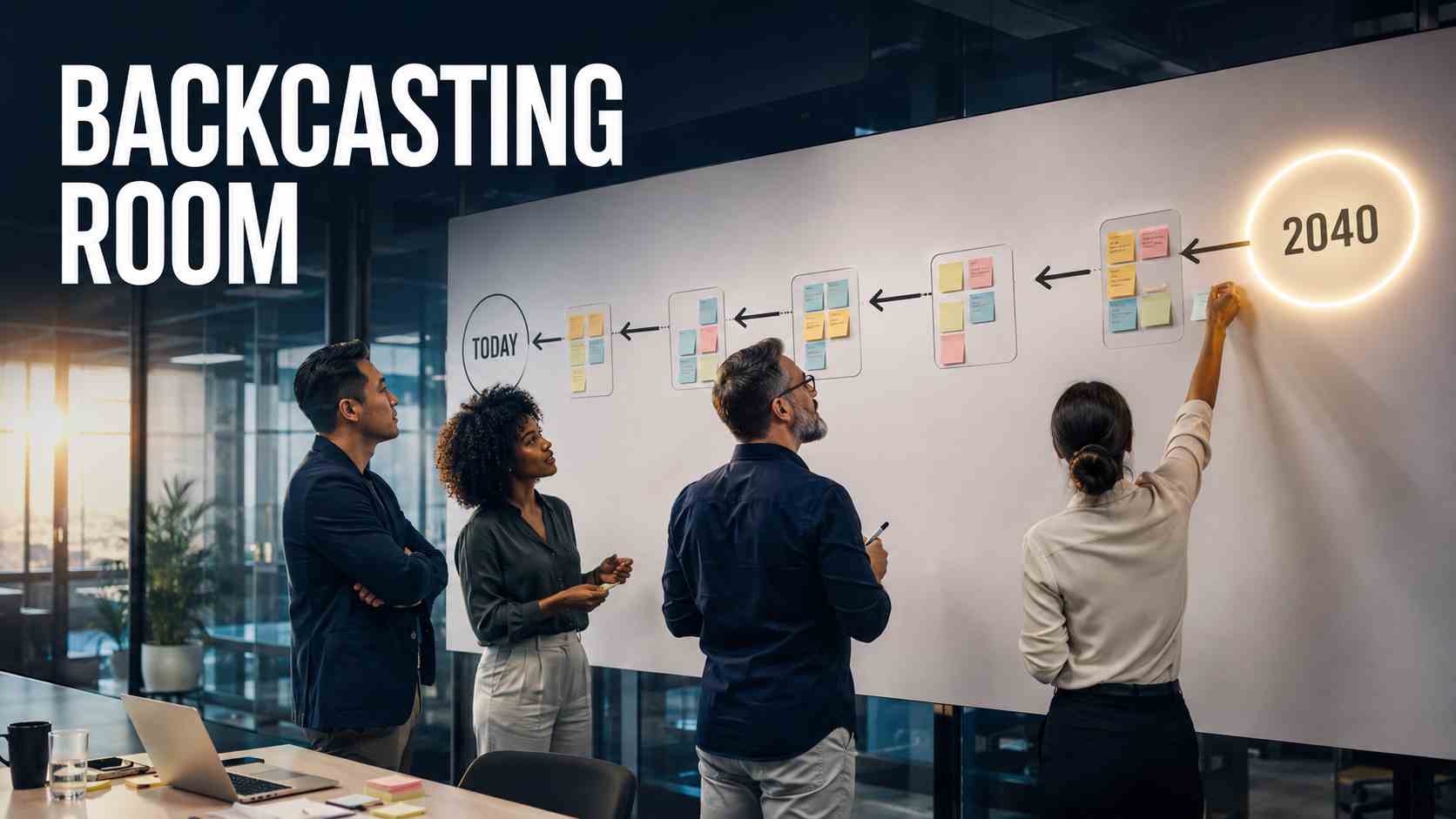
A back casting room is simply the working space; it can be physical or virtual, where a team runs a back casting session.
Back casting is a planning method that starts by defining a specific, desirable future and then works backward, year by year, to determine what must happen today to reach it. The room is not the method. It is the whiteboard, the timeline on the wall, and the people doing the work.
Where Back casting Actually Came From
Back casting is not a buzzword invented for a corporate offsite. The term came out in 1982 by John B. Robinson, an energy researcher who later worked at the University of Waterloo and the University of Toronto, in a paper on long-term energy policy.
Robinson said it wasn't enough to guess future energy needs by looking at the past. Instead, people should first decide what kind of future they want and then plan how to achieve it.
He proposed starting with a specific future scenario and tracing the steps backward to the present, rather than projecting forward from today's data. The method spread from energy policy into sustainability planning through the 1990s.
The clearest large-scale example is The Natural Step, a framework developed in Sweden by physician Karl-Henrik Robèrt, which uses what it calls back casting from principles: organizations define a future state that meets four science-based sustainability conditions, then work backward to identify which current activities need to change first. The Natural Step has applied this approach with companies and municipal governments across multiple countries for more than three decades.
How a Back casting Session Runs.
A back casting session, wherever it happens to take place, generally moves through four stages.
1. Define the future state. The group agrees on a specific, dated vision, not a vague aspiration. "Carbon neutral by 2040" is a back casting target. "Be more sustainable" is not, because it gives the team nothing to plan backward from.
2. Check that vision against constraints that will not change, such as physical limits, regulations, or budget ceilings, so the group is not back casting from a future that was never possible.
3. Work backward in stages. Starting at the target date, the group asks what had to be true two or three years earlier for that end state to exist, then repeats the question at each earlier interval until it reaches the present.
4. Convert the backward map into a forward plan, with owners, milestones, and dates attached to each step, so the session produces an action list rather than just a wall of sticky notes.
Because that process depends on people building a shared timeline together in real time, most teams do reserve an actual room or a dedicated virtual whiteboard for it.
Large wall space matters more than any specific software: the value comes from everyone seeing the same timeline take shape, not from a particular tool.
Back casting vs. Forecasting
Although both methods help organizations plan for the future, they answer different questions.
Forecasting starts with today's data and trends to predict what is most likely to happen next. It works best when the future is expected to look similar to the present.
Back casting takes the opposite approach. It starts with a clear picture of a desired future and then works backward to identify the actions needed to make that future a reality. It is especially useful for innovation, sustainability, and long-term transformation.
Forecasting
| Back casting
|
|---|
Starts with current data and trends. | Starts with a desired future outcome |
Predicts what is likely to happen. | Plans what needs to happen to reach a goal. |
Best for stable environments and short-term planning. | Best for long-term change and breakthrough goals. |
Answers: "What is likely?" | Answers: "What is possible?" |
A Real-World Example
SHRM uses Blockbuster and Netflix to illustrate the difference.
A forecasting approach at Blockbuster in the early 2000s focused on protecting its profitable late-fee business because existing data suggested that model would continue to generate revenue.
A back casting approach would have started with a different question: "How do we become the leading way people watch movies by 2015?"
Working backward from that goal would likely have pointed to investing in streaming technology years before it became an industry standard.
Netflix followed a strategy much closer to that vision and built the streaming platform that eventually reshaped the entertainment industry, while Blockbuster failed to adapt.
Where do back casting organizations use this?
Back casting is used in many industries, but it is most common in sustainability and long-term planning. Robinson originally developed the method to help organizations plan for future energy and environmental challenges.
Some common applications include:
Sustainability and energy planning
Governments and organizations work backward from long-term goals, such as reducing carbon emissions or reaching renewable energy targets.
City and regional planning
Planners start with future housing, transportation, or climate goals and identify the steps needed to achieve them over the coming decades.
Corporate strategy
Businesses use back casting to plan product roadmaps, enter new markets, or achieve a desired competitive position.
Human resources
HR teams define what their workforce should look like in five or ten years, then plan today's hiring, training, and development efforts to reach that goal.
What All These Uses Have in Common
No matter the industry, the process follows the same basic approach:
Define a clear and specific future goal.
Work backward to identify the milestones needed to reach it.
Consider real-world constraints, such as budget, time, and resources.
Assign owners and deadlines to each milestone so the plan can move forward.
How to Set Up a Room for a Back casting Session
A successful back casting session depends less on the room itself and more on how you organize the workshop. Follow these steps to create an environment where participants can build a realistic roadmap together.
Step 1: Create a Large, Shared Timeline
Give everyone a clear view of the journey from the future back to today.
Use a wall with sticky notes, a whiteboard, or a digital collaboration tool like Miro or Microsoft Whiteboard.
Lay out a timeline that covers the full planning period, whether that's 5, 10, or 20 years.
Make sure everyone can see and contribute to it throughout the session.
Step 2: Invite the Right Participants
A back casting workshop works best when it includes the people who understand how the work actually gets done.
For example:
A workforce planning session should include HR leaders, hiring managers, and learning and development teams.
A sustainability workshop should involve operations, finance, and environmental specialists alongside senior leadership.
The goal is to combine strategic decision-makers with people who know the practical challenges.
Step 3: Set a Clear Future Goal
Before mapping any actions, make sure everyone agrees on the desired outcome.
Ask questions such as:
What does success look like in 10 years?
Which measurable goal are we trying to achieve?
How will we know we've reached it?
A specific target keeps the discussion focused.
Step 4: Allow Enough Time
Back casting is a strategic exercise, not a quick brainstorming meeting.
Plan for a half-day or full-day workshop whenever possible.
Give participants enough time to discuss milestones, assumptions, risks, and dependencies without rushing.
Step 5: Build the Roadmap Backward
Starting with the future goal, work backward to identify the milestones needed to reach it.
For each milestone, decide:
By the end of the session, you'll have a practical action plan that connects today's decisions to your long-term vision.
Common Mistakes That Undercut a Back casting Session:
The most frequent failure is starting from a vague aspiration instead of a specific, dated target.
A great place to work gives a team nothing to work backward from. A usable target names a measurable state and a year.
The second common mistake is skipping the constraint check in step two and back casting from a future that was never physically or financially possible, which produces a plan nobody can execute.
The third is stopping at the backward map and never converting it into a forward plan with owners and dates, which leaves the session as an interesting exercise rather than a working strategy.
Once you know what actually happens inside a real back casting session, the label on the door stops mattering. The questions people usually search next are answered directly below.
Frequently Asked Questions
1: Is a back casting room a specific physical space with required equipment?
No. There is no standardized design or required equipment. It refers to whatever space, physical or virtual, a team uses to run a back casting session, and the value comes from the process, not the room itself.
2: What is the difference between back casting and scenario planning?
Scenario planning typically explores several possible futures side by side to prepare for uncertainty. Back casting commits to one specific, desired future and works backward from it to build a path toward that outcome.
3: Who invented back casting?
John B. Robinson coined the term in a 1982 paper on energy policy, and later formalized the approach through his research at the University of Waterloo.
4: Can a small team use back casting without a formal workshop?
Yes. The core steps, defining a specific future, checking constraints, and working backward in stages, scale down to a small team with a whiteboard and a few hours, though larger organizational goals usually benefit from a longer, more structured session.
5: Is back casting only used for sustainability projects?
No. It started in energy and sustainability planning but is now used in corporate strategy, urban planning, and workforce planning, anywhere a team needs to work from a specific long-term target back to present-day decisions.